Pages

Showing posts with label tools. Show all posts

Tuesday, June 8, 2010

Banana Leaves as Wrapper

If you have ever visited Indonesia or other tropical country, especially those in South-east Asia, you should ever saw banana trees.


(source)


Banana tree is one of the trees that almost each of its parts is useful. In Indonesia as well as in other neighbor South-east Asian countries, if you ever tried the traditional food there or went to the traditional market in those countries – I’m sure you should ever saw banana leaves that is used as food wrapper or plate cover that function just like food oil paper.

Banana leaves wrapper is the coolest plate I’ve ever known. Other than it is waterproof, the banana leave is also easy to be torn that if when we eat we don’t have spoon, we can just torn the leaf a little, then bend it and use it as a spoon.

Another advantage of this: environmentally friendly. When it’s not used anymore, the waste of banana leaves could directly decompose in the soil, we don’t need worrying about recycling it. Other than that, the banana tree also grow faster than other trees that usually used as paper material, so even though we are a bit more often use banana tree as food wrapper, we don’t need to worry about cleared forests as long as we still keep take care of the environment and do not over-use it.

(FK)

Sunday, June 6, 2010

Lidi(Sticks) Broom


Lidi Broom (source)


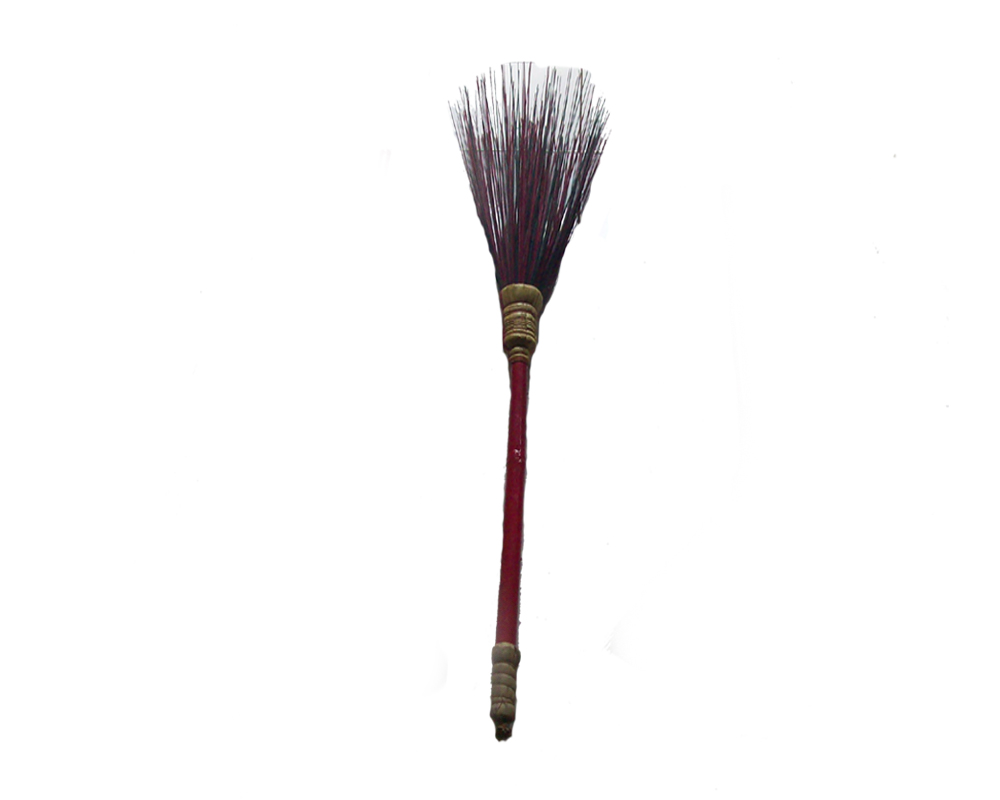
Other than ‘ijuk’ broom, there is another type of broom I know: lidi (sticks) broom. Lidi broom is made from coconut leaves’ bones those are tied together. Usually lidi broom in the villages is without handle, but if it is added with handle, then you can imagine the witch’s broom. Hehe…


'Witch Broom'=p (source)


The lidi broom usually used to sweep the yard or grass field. But on the expansion, the lidi broom is also used in other places.

In the area where I live, when people plaster the floor with cement, they usually will pat and flattening it with lidi broom to make the texture become a little rough.
Another thing, in some food sellers in tents on the street that cook with flaming fire and they should cleaned up the pan very often to cook the next order, they use the lidi broom to clean up the pan. Of course that lidi broom is NOT the one they use to sweep the floor…

There are also lidi brooms with more flat shape and look cleaner. This one, usually people use it to clean up the bed and pat pillows and bolsters.
I don’t know how about in other areas. Maybe there are still a lot of variety of shapes and usages of lidi broom. Next time if I find out some more, I’ll write another sharing. Ciao!

(FK)

Thursday, June 3, 2010

Palm Fiber (Ijuk) Broom


A palm fiber (Ijuk) Broom (source)


Everyone must know what a broom is. What are the materials to make a broom then? I am not sure how nowadays kids would answer it. Maybe they’ll answer broom is made from plastic and wood as its cane.

If it was when I was a little kid, we would usually answered broom was made from palm fiber (ijuk) or coconut’s hairs and rattan or wood as its cane.

At first I didn’t really pay attention to this thing. A broom for me was just a tool to clean up the house. Nothing special about it. I was just realized palm fiber broom specialty lately when I grew up and ever had chance to live in a big city.

When I went to supermarket, I saw the brooms sold there, most of them were made from plastic and wood as their cane. At the beginning I really liked the broom with plastic hair because we can wash it and the hair also not easily broken, so it could last longer.

However after I re-considered, it came out that the palm fiber broom apparently has more benefit rather than plastic broom – at least based on me and my mom’s opinions. My mom felt that the floor is cleaner when she swept using palm fiber broom because the dusts and the dirt could roof at the palm fiber hairs. Other than that, according to my mom, the palm fiber texture which is more flexible makes her prefer using the palm fiber broom.

As for me, I have other reasons that I just thought lately. I used to dislike palm fiber broom because it was easily broken compared to plastic broom and if it was soaked, the palm fiber would be lumpy and not that comfortable to be used. But then I realized there were many advantages using palm fiber broom.

The palm fiber broom is more environmentally friendly. With its materials which are from palm fiber and rattan or wood, if it is unused anymore, the waste could just decomposed and processed directly by nature. Other than that, because the productions of palm fiber brooms are usually done by many small and medium businesses, by buying the palm fiber broom we could support the broom craft-men’s businesses. So, now I prefer using palm fiber broom. =)

(FK)

Wednesday, June 2, 2010

Winnow


winnow (source)

Rice is the staple food of Indonesian, especially those who live in the west and the middle zone. In Indonesia, the cooked rice is called ‘nasi’, while the raw rice is called ‘beras’. The rice is actually the fruit of paddy grains. When it was harvested, sometimes there are still many rice skins (grains) left and mixed with the rice.

Today when I was about cooking the rice, as usual I removed the dirt – small rocks and/or the grains- which are mixed in the rice. Now I don’t use any special tool to sort out the grains from the rice, but it brings memory when I was little I used to love threshing rice by winnowing.

Winnow is a large plate made from woven bamboo. The shape is round with rattan circling ring. When I was still a little kind – and I don’t know since how many years before that – when the rice sold usually still mixed with lots of grains and dirt because the farmers still hadn’t use the modern rice peeler, a lot of people used winnow to clean rice from grains.

The way to do it was by pour small amount of rice on the winnow, then swing that winnow up and down that the rice and the grains are jumping around. The logic is like this: grains are the paddy’s skins – which are very light, so when the grains and the rice are jumping in the air, a small wind would be able to blow the light grains aside and separate it from the rice. I really loved did that because the sound produced when the rice was dancing and jumping around on the winnow sounded like music, moreover if there were many people did that together each with different rhythm, we could really produced ‘the song of the rice’. ^^

Maybe winnowing is still popular in more remote villages or between the farmers. However in the city, most of the people chose to buy really clean rice that no more mixed with grains that they no longer need to thresh the rice. So it turns out the winnow now switching function as a base for serving food. Usually the winnow is used as the ‘plate’ for huge rice cone or various traditional and modern snacks. It is a cheap plate, and of course unique because it is added the traditional sense in the presentation.

[FK]